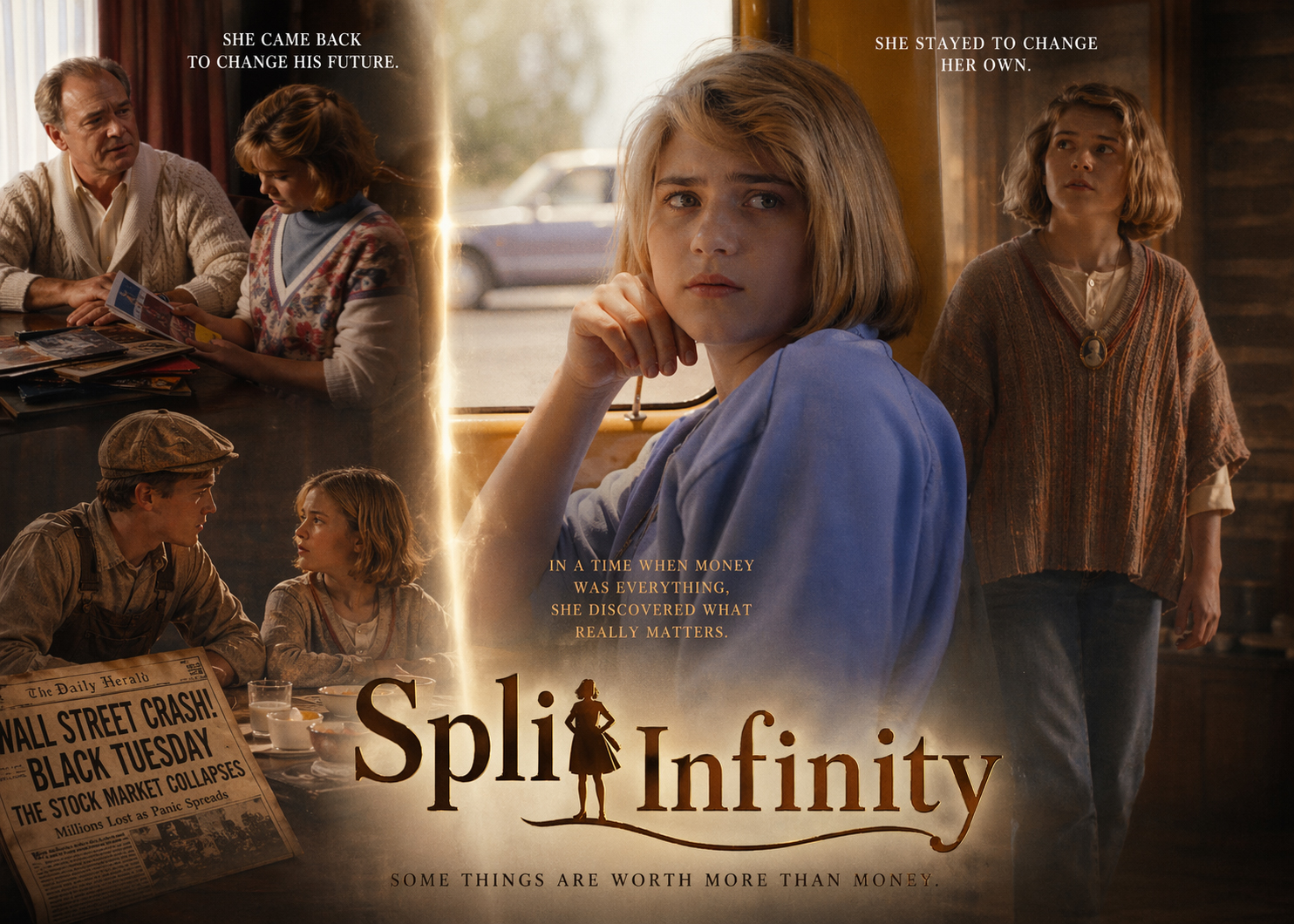
About Split Infinity
AJ Nolton is thirteen years old, sharp, and completely convinced that money solves everything. She subcontracts her household chores, runs a candy business at baseball games, and has written a school report called "People Who Profited from the Great Depression" — with genuine admiration. Then she falls through a barn loft and wakes up in 1929, inside the body of her great-aunt Amelia Jean, two weeks before the stock market crashes.
What AJ planned to do — profit from her knowledge of the future — runs into an immediate problem: the only person who might believe her is her grandfather Frank, a young man who is about to sell the family farm to invest in the market. Everything AJ knows about the future makes her the one person who can stop him. And she fails. Black Tuesday happens. The farm is mostly lost.
But something else also happens. While AJ is busy trying to save the family fortune, she builds something that wasn't in the plan — Future World, an amusement park she creates for the community, the first project she has ever done entirely for someone other than herself. It doesn't make her rich. It doesn't save the farm. But it keeps the house and barn for Ruth, who never asked for anything for herself. And it turns out to be the thing AJ is proudest of when she finally goes home.
Grandpa's final reveal is the film's emotional payoff: the hospital for children, built with the Future World money, named for Amelia Jean. AJ went back in time to make money. What she actually built was a legacy of generosity that lasted sixty years. "This is how you got rich," he tells her. And this time, she understands what rich means.
I realized I always had everything I ever wanted. Just never knew it. I wish my family was here. I'd love for them to see this.— AJ, Split Infinity
Your Five-Day Journey
The Full Curriculum is on Its Way
The five-day guided program for Split Infinity is currently in development. Join the waitlist to be notified when it's ready — and to receive early access pricing.
Join the WaitlistWhat Children Are Building
Split Infinity is anchored in Self-Awareness and Social Awareness — specifically the shift from a money-first worldview to an understanding of what wealth actually means, and the discovery that building something for others is more satisfying than anything you can build for yourself.
Money vs. True Wealth
AJ goes back to the Depression believing money is everything — and spends two weeks watching that idea fail at every turn. Ruth has almost nothing and says she already has everything she ever wanted. AJ has all the knowledge in the world and can't use it. Children explore: what is Ruth measuring with, and is she right?
What We're Actually Chasing
AJ wants money — but underneath that, she wants to belong, to matter, to not feel invisible. The film separates those things clearly and asks which one money can actually get. Children explore the difference between what we say we want and what we're really after.
Building for Others
Future World is the first thing AJ has ever built for someone else's benefit. She doesn't plan it that way — it emerges from trying to help Ruth keep the house. Children examine what it feels like to create something for others, and why AJ's pride in it is different from anything she's felt before.
Gratitude & Perspective
AJ's final diary entry — "I always had everything I ever wanted, I just never knew it" — is the emotional payoff of the whole film. Children explore what changes her perspective: not a speech or a lesson, but two weeks of watching people who have nothing and are grateful for it.
The Limits of Knowledge
AJ knows the future. She knows about Black Tuesday, about the crash, about what companies will thrive for decades. And she can't stop any of it. Children explore a fascinating question: if knowledge alone isn't enough to change things, what is? What actually changes the outcome?
Legacy — What We Leave Behind
Grandpa's hospital, named for Amelia Jean, built with Future World money, still standing sixty years later — this is what AJ actually built when she thought she was trying to make money. Children explore what it means to leave something behind that outlasts you, and whether that's something you can plan for or only discover.
Who Children Will Watch Closely
The curriculum asks children to observe characters rather than evaluate themselves — a key distinction that makes the learning land without triggering defensiveness.
AJ is sharp, entrepreneurial, and completely convinced that money is the answer to everything she doesn’t have — friends, beauty, belonging. She runs a candy business, a tutoring operation, and a concession stand all at once. The film sends her back to 1929 with none of her tools — and she discovers what she’s been getting wrong about herself all along.
“AJ wants to be rich more than anything. By the end, what does she want more?”
In the present, Frank is Grandpa — old, simply dressed, dismissed. In 1929 he is twenty years old and wants to sell the family farm to get rich. AJ goes back thinking she’ll save him from his mistake. What she discovers is that Frank is her — the same hunger, the same blind spots, the same certainty. Watching them together is the mirror the film holds up all week.
“Frank and AJ want exactly the same things. Why does the film treat their stories so differently?”
The Film's Friction Points
These are the scenes where the SEL learning runs deepest — where children feel the shift in the story before they're asked to name it.
AJ is embarrassed by her mom — and buys her an outfit instead of apologizing
Mom comes to school in sweats just to deliver AJ’s forgotten report. AJ is mortified. Later, she buys her mom new clothes. Mom says: “All I really wanted was for you to say I’m sorry.” AJ’s first clear portrait — and her first clear blind spot.
AJ meets her grandfather as a twenty-year-old who wants to sell the farm
The boy who picks AJ up from the 1929 principal’s office is Frank — the grandfather she dismissed as out of touch. He is brilliant, ambitious, and about to make the worst decision of his life. AJ realizes she sounds exactly like him. Students feel that recognition before she does.
AJ refuses to help Frank get rich — even though she could
Frank discovers AJ knows about Black Tuesday. He tells her this is a gift from God — an opportunity to make the family rich forever. AJ almost agrees. Then she says no. “That’s not why I’m here.” The first time she chooses purpose over profit.
Frank lets them take AJ — and she tells him it’s okay
The investors and sheriff come to take Future World apart and take AJ away. Frank stands aside. AJ doesn’t fight. She hands him the locket and says: “There’s nothing more I can do, Frank. It’s up to you now.” The most important line in the film.
Grandpa shows AJ the Amelia Jean Hospital for Children
AJ comes home thinking she failed. Grandpa shows her what she built without knowing it — a children’s hospital named after the great-aunt she replaced in 1929. “This is how you got rich.” Not a bank account. A legacy. And he asks her to take it over.
What Children Are Building
Split Infinity is anchored in Self-Awareness and Social Awareness — specifically the shift from a money-first worldview to an understanding of what wealth actually means, and the discovery that building something for others is more satisfying than anything you can build for yourself.
Money vs. True Wealth
AJ goes back to the Depression believing money is everything — and spends two weeks watching that idea fail at every turn. Ruth has almost nothing and says she already has everything she ever wanted. AJ has all the knowledge in the world and can't use it. Children explore: what is Ruth measuring with, and is she right?
What We're Actually Chasing
AJ wants money — but underneath that, she wants to belong, to matter, to not feel invisible. The film separates those things clearly and asks which one money can actually get. Children explore the difference between what we say we want and what we're really after.
Building for Others
Future World is the first thing AJ has ever built for someone else's benefit. She doesn't plan it that way — it emerges from trying to help Ruth keep the house. Children examine what it feels like to create something for others, and why AJ's pride in it is different from anything she's felt before.
Gratitude & Perspective
AJ's final diary entry — "I always had everything I ever wanted, I just never knew it" — is the emotional payoff of the whole film. Children explore what changes her perspective: not a speech or a lesson, but two weeks of watching people who have nothing and are grateful for it.
The Limits of Knowledge
AJ knows the future. She knows about Black Tuesday, about the crash, about what companies will thrive for decades. And she can't stop any of it. Children explore a fascinating question: if knowledge alone isn't enough to change things, what is? What actually changes the outcome?
Legacy — What We Leave Behind
Grandpa's hospital, named for Amelia Jean, built with Future World money, still standing sixty years later — this is what AJ actually built when she thought she was trying to make money. Children explore what it means to leave something behind that outlasts you, and whether that's something you can plan for or only discover.
Who Children Will Watch Closely
The curriculum asks children to observe characters rather than evaluate themselves — a key distinction that makes the learning land without triggering defensiveness.
AJ is sharp, entrepreneurial, and completely convinced that money is the answer to everything she doesn’t have — friends, beauty, belonging. She runs a candy business, a tutoring operation, and a concession stand all at once. The film sends her back to 1929 with none of her tools — and she discovers what she’s been getting wrong about herself all along.
“AJ wants to be rich more than anything. By the end, what does she want more?”
In the present, Frank is Grandpa — old, simply dressed, dismissed. In 1929 he is twenty years old and wants to sell the family farm to get rich. AJ goes back thinking she’ll save him from his mistake. What she discovers is that Frank is her — the same hunger, the same blind spots, the same certainty. Watching them together is the mirror the film holds up all week.
“Frank and AJ want exactly the same things. Why does the film treat their stories so differently?”
The Film's Friction Points
These are the scenes where the SEL learning runs deepest — where children feel the shift in the story before they're asked to name it.
AJ's Report on Depression Profiteers
The film opens with AJ reading her report — written with genuine admiration for people who made money during the worst economic collapse in American history. Ms. Leman's reaction is the audience's reaction, but the curriculum doesn't treat AJ as a villain. Children are asked: where does AJ's worldview come from, and is it entirely wrong? The goal is curiosity, not judgment — because AJ's transformation only works if children can see themselves in where she starts.
Ruth's Answer
Frank promises his mother she could have "everything she ever wanted" once he sells the farm and invests the money. Ruth's response — "Everything I ever wanted, I've already got" — lands differently depending on where you are in life. Children are invited to sit with it: does Ruth sound sad, or content? What would it actually feel like to mean that? And what does AJ think when she hears it?
AJ Refuses to Help Frank Get Rich
Frank figures out AJ knows the future and asks her to help him use that knowledge to profit. AJ refuses — not because she's become a saint, but because she finally understands that's not why she's there. "There's more to life than selling this farm and making money," she tells him. Children watch the money-obsessed girl from the opening scenes say something she would have laughed at a week earlier. The curriculum asks: what changed?
Building Future World
AJ builds an amusement park — not to get rich, but to make enough money to keep the house and barn for Ruth. It's chaotic, creative, and genuinely fun. The curriculum uses this scene to explore what it feels like to work toward someone else's happiness. AJ is still herself — running a business, thinking in numbers — but the purpose has shifted entirely. Children are asked to notice that difference.
After the Crash
Frank comes to AJ after Black Tuesday, hat in hand, to tell her she was right. He lost everything. He also says — after a pause — "I guess not everything." The farm is mostly gone. But the house stands. The family is together. And he understands now what Ruth meant. Children watch someone whose whole plan collapsed discover that the thing underneath the plan was still there.
The Hospital
Grandpa shows AJ the Amelia Jean Hospital for Children — built with the Future World money, named for her great-aunt, still serving children sixty years later. "This is how you got rich," he tells her. AJ went back in time thinking she would profit from the Depression. She built a children's hospital instead. Children sit with the gap between what AJ planned and what she actually made — and what that means about how legacy actually works.