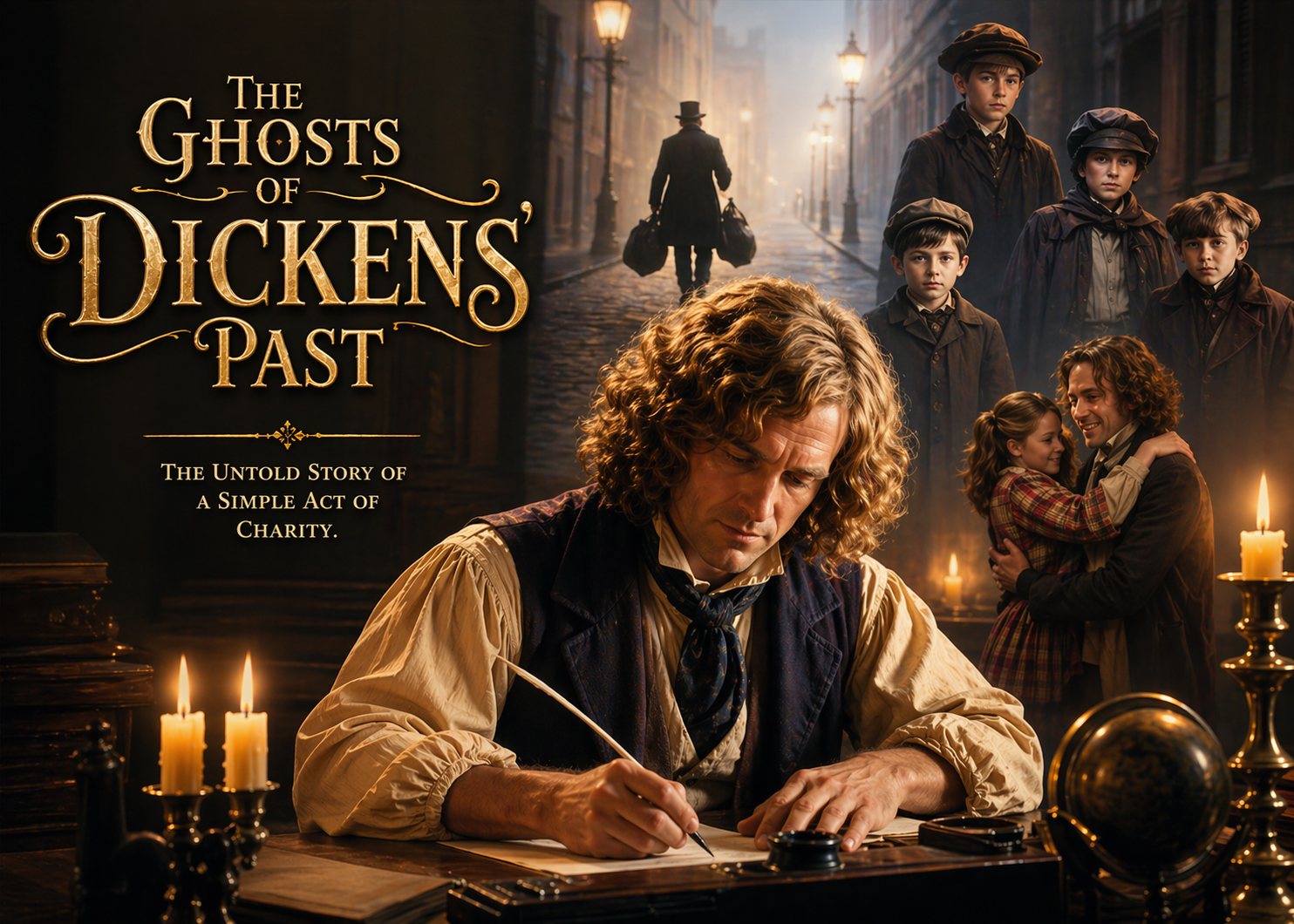
About The Ghosts of Dickens' Past
London, 1843. Charles Dickens is in crisis — creatively blocked, financially desperate, and gripped by a fear of poverty rooted in his own childhood. As a boy, he watched his father go to debtor's prison and spent his own days in a blacking factory, one of the hopeless children he now writes about. He needs to produce something quickly, something that will sell. But his mind is frozen — until a mysterious young girl leads him into the streets at night and shows him everything he's been too afraid to see.
What unfolds is a journey through Victorian London that becomes the real-life version of what Dickens would write into A Christmas Carol. The girl shows him a wealthy miser eating alone, surrounded by everything money can buy and utterly without joy. She shows him a family in poverty whose bare room is "a palace" to them and whose love for each other is richer than anything Dickens has ever written. She takes him to a neglected grave — and the man standing beside it, trying to tend it after seven years of searching, turns out to be Scrooge himself. Marley's partner. The man who changed.
The film's central insight is quiet and profound: Dickens couldn't write A Christmas Carol when he was thinking about money. The moment he stopped — the moment a simple act of charity toward a homeless family shifted his attention from himself to someone else — the story poured out of him. The film teaches children that the same fear which blocks our generosity also blocks our creativity, our purpose, and our peace.
Suddenly, without even being conscious of it, my mind moved from thoughts of myself to thoughts of someone else. That night, for the first time in many days and nights, the thought of needing to make money finally left me.— Charles Dickens, The Ghosts of Dickens' Past
Your Five-Day Journey
The Full Curriculum is on Its Way
The five-day guided program for The Ghosts of Dickens' Past is currently in development. Join the waitlist to be notified when it's ready — and to receive early access pricing.
Join the WaitlistWhat Children Are Building
The Ghosts of Dickens' Past is anchored in Self-Management and Social Awareness — specifically how fear of not having enough can close us off from both generosity and purpose, and how the simple act of looking outward can unlock what looking inward never could.
Generosity vs. Greed
The film doesn't frame greed as villainy — it frames it as fear. Children see how Dickens' desperate clinging to money is the same impulse that made Scrooge what he was. The question isn't "are you greedy?" but "what are you afraid of losing?"
Fear of Scarcity
Dickens' childhood in the factory and his father's time in debtor's prison left a wound that never fully healed. Children explore how past experiences of "not enough" can drive adult decisions in ways that aren't always visible — and how that fear can be named and faced.
The Power of Shifting Focus
The turning point for Dickens isn't a grand revelation — it's a basket of food left on a doorstep. Children discover what research confirms: thinking about others, giving to others, and acting for others is one of the most powerful ways to break the grip of anxiety and self-focus.
Creativity & Purpose
Dickens couldn't write when money was the goal. The moment his purpose shifted — when he wanted to write something that would actually help people — the words came. Children explore the connection between meaning, motivation, and doing our best work.
True Wealth
The poor family the girl shows Dickens has nothing by any measure — and more love, gratitude, and joy than the wealthy miser eating alone. Children are asked to examine what they believe wealth actually means, and what they would rather have.
A Single Act's Reach
One small act of charity toward a homeless family unlocked one of the most beloved stories in the English language — a story that has changed lives for 180 years. Children sit with the idea that we rarely know the reach of what we choose to give.
Who Children Will Watch Closely
The curriculum asks children to observe characters rather than evaluate themselves — a key distinction that makes the learning land without triggering defensiveness.
Dickens is brilliant, successful, and consumed by a fear of poverty that goes all the way back to the boy he once was. He is not a villain — he is someone whose past wound is quietly running his present decisions. His arc is one of the most honest portraits of how fear masquerades as practicality, and what it takes to finally see through it.
"What do you think Dickens was most afraid of — and was that fear reasonable given what he'd been through as a child?"
She may be supernatural. She may simply be extraordinary. She refuses payment for a debt Dickens owes her, leads him through the streets without explanation, and shows him exactly what he needs to see at exactly the right moment. Her final words — "May God bless us, everyone" — are the line Dickens will give to Tiny Tim. She is the ghost in his story before he knew he was writing one.
"Who do you think the girl really was? What makes you think that?"
The man Dickens meets at Marley's grave is Scrooge — seven years after the events of A Christmas Carol, tending the grave of his old partner. He never announces who he is. Children piece it together from context. He is both the warning of what Dickens could become and the proof that people can change — a man who once chose money over everything, now choosing to tend a grave no one else remembers.
"The man at the grave had clearly changed from who he used to be. What do you think made the difference for him?"
When Dickens returns from his night in the streets convinced he has lost his mind, Ms. Burdett-Coutts refuses to pity him. She is the wealthiest woman in England and one of history's great philanthropists — and she tells him plainly: "You are not going mad. God has set his hand to help you and you have chosen not to see it." Her directness is the final push he needs.
"Ms. Burdett-Coutts didn't comfort Dickens — she challenged him. Why do you think that's what he actually needed?"
The Film's Friction Points
These are the scenes where the SEL learning runs deepest — where children feel the weight of the story before they're asked to discuss it.
Dickens Tells the Story of His Boyhood
Sitting on a cold bench with William, Dickens recounts being sent to sell his family's books one by one — and what it meant when they were gone. His childhood in the factory, his father in debtor's prison. Children begin to understand why the fear of poverty isn't just selfishness — it's a wound. The curriculum asks: how does what happened to us shape what we're afraid of?
The Ragged School
Dickens accompanies Ms. Burdett-Coutts to a school for London's poorest children — some of them orphans, some of them agents of thieves, all of them desperate. She gives generously. Dickens gives begrudgingly. When she asks if he has anything for the children, he says flatly: "I do not have your means." It's the line that haunts him for the rest of the film.
The Poor Family's Room
The girl takes Dickens to a cold, cramped room where a family eats a meager meal with no fire. He expects to see misery. What he sees instead stops him completely: they love each other. They are grateful for what they have. Their room is a palace to them. The curriculum asks children what they think Dickens was expecting — and what changed when he actually looked.
The Neglected Grave
The girl brings Dickens to a cemetery and shows him one grave, neglected and overgrown while all the others are tended with flowers. She tells him: the man buried there believed that what he needed most in life was money — and not one soul who truly knew him cared enough to visit. Then she quietly asks Dickens if any of this applies to him. Children feel the weight of the silence before he answers.
The Basket on the Doorstep
The turning point of the whole film: Dickens, on his way home, quietly leaves a basket of food and a pouch of money on the doorstep of a homeless family. Nobody is watching. Nobody will know. He doesn't do it for credit. And in that moment — the moment his attention moves from himself to someone else — the story that will outlast him finally begins to form. Children are asked: why did that act unlock what months of effort couldn't?
Scrooge at Marley's Grave
The film's most quietly stunning moment: the man at the grave introduces himself as the old miser's former business partner. Children who know A Christmas Carol begin to piece it together — this is Scrooge, seven years later, changed. He tells Dickens he has searched for the girl for seven years without finding her. The curriculum gives children space to sit with what that means.