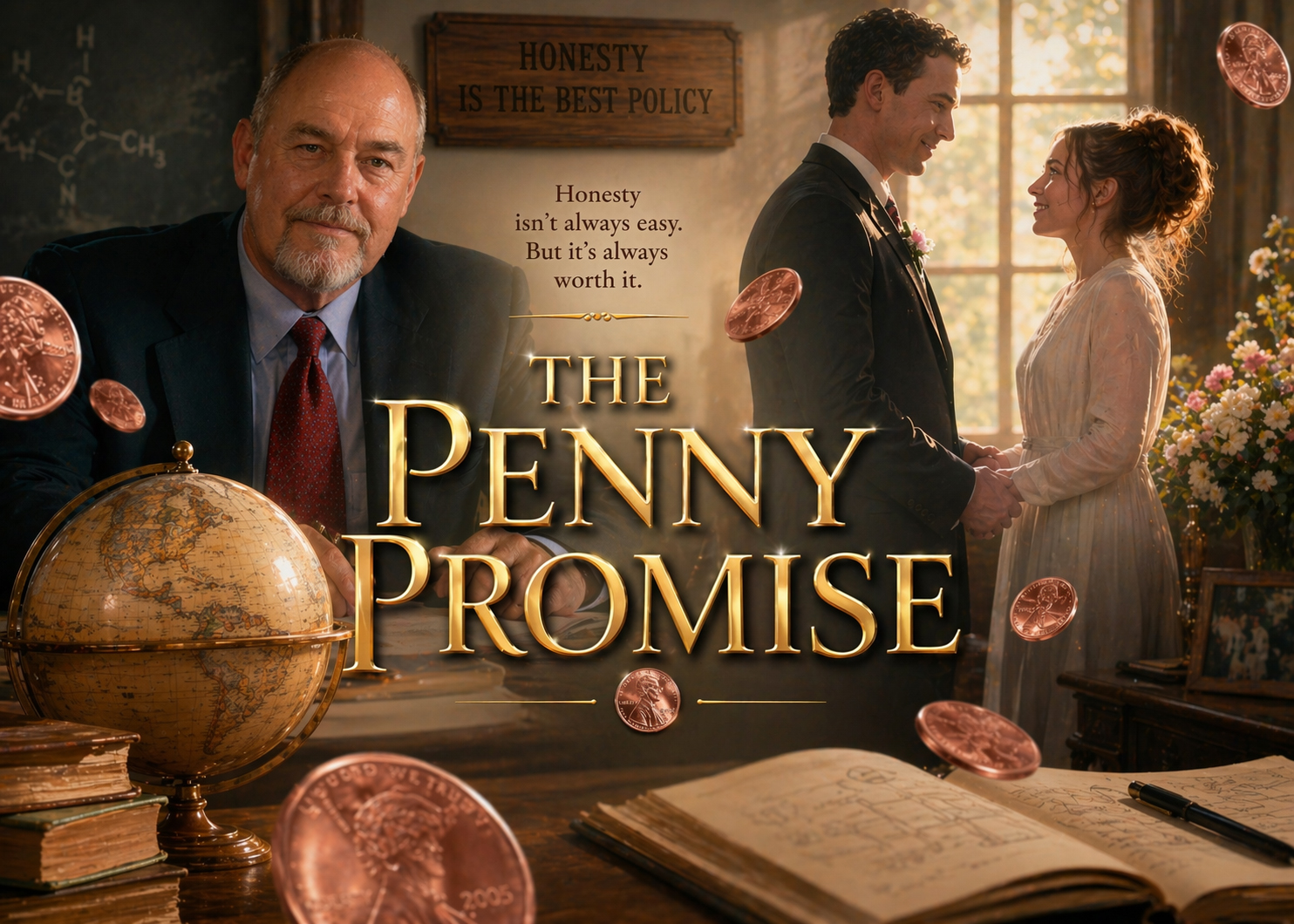
About The Penny Promise
Will Duncan is a science teacher who rollerblades everywhere, leaves IOU notes on gumball machines, and believes — without irony — that everything has value, everything and everyone. He is also the most honest person in any room he enters, which turns out to be both his greatest gift and the source of all his trouble.
When Will asks Annie's father for permission to marry her, Mr. Farnsworthy sets what he thinks is an impossible condition: save a million pennies — $10,000 — and Will can have his blessing. The trap is meant to buy time for Annie to fall for George Hampton, the wealthy, charming man the Farnsworthy parents have picked out for her. Will doesn't see the trap. He sees a promise, so he makes it.
What follows is a cascade of honest misfortunes, comic disasters, and moral tests — each one revealing more about who Will is. He finds $150,000 in cash hidden inside a globe and immediately sets about finding its rightful owner rather than keeping it. He gets framed, arrested, fired, and dragged into court. And at the most critical moment — when the truth would set him free — he refuses to speak it, because speaking it would break a separate promise he made to a frightened boy. He would rather go to jail than break his word.
The film is a comedy, but its comedy comes entirely from watching a man whose integrity is so absolute it becomes almost impossible — and from watching everyone around him slowly realize that this is exactly the kind of person worth knowing.
Honesty may not always seem to pay off in this lifetime, but I'd rather be an honest man in jail than a dishonest man who's free. I made a promise and I'm not going to break it.— Will Duncan, The Penny Promise
Your Five-Day Journey
Each day builds on the last — moving from first encounter with Will and the world he lives in, through the mounting tests of his integrity, and finally to the moment his example quietly changes everyone around him.
Day One
Who Will Is — and the Promise
We meet Will through the things he does before anyone is watching: returning a lost wallet via dog sled, leaving an IOU note on a gumball machine, telling someone their hat is ugly because they asked for his honest opinion. We also meet the Farnsworthy family, George Hampton, and the impossible promise Mr. Farnsworthy extracts. Children are asked: what does it tell us about a person when they keep promises nobody else is enforcing?
Day Two
The Globe — and What's Inside It
Will buys a battered globe from George for ten dollars and discovers $150,000 in cash hidden inside. For one brief, ridiculous, magnificent moment he throws the bills in the air and dances. Then he asks the question that defines the rest of the film: who does this money really belong to? Children explore why Will doesn't just keep it — and what that choice reveals about how he sees the world.
Day Three
The Setup — and the Cost of Integrity
George and Rudy engineer Will's arrest for stealing quarters from a phone booth. The money from the globe disappears. Will loses his job and his reputation, and finds himself facing trial in a courtroom presided over by Mr. Farnsworthy himself. Children watch what it looks like when doing the right thing makes everything worse — and are asked whether that changes what the right thing is.
Day Four
The Promise He Won't Break
Will knows the truth that would clear his name — but telling it would break a promise he made to Dustin. He refuses. Even in the holding cell, even facing a guilty verdict, he won't speak it. His lawyer begs him. Dustin begs him to let him off the hook. Will's answer is the moral center of the film: "I'd rather be an honest man in jail than a dishonest man who's free." Children sit with what that costs — and what it means.
Day Five
Dustin's Choice — and the Lucky Penny
Dustin stands up in court and tells the truth — every word of it, including the part that incriminates himself — because watching Will choose jail over dishonesty showed him something he couldn't unsee. Then Mr. Farnsworthy, the man who set the impossible trap, gives Will his most precious possession: the first penny he ever earned. An honest heart, he admits, is worth more than any amount of money. Children explore how one person's integrity can quietly transform everyone around them.
What Children Are Building
The Penny Promise is anchored in Self-Management and Responsible Decision-Making — specifically what it looks like to maintain integrity not in a single dramatic moment, but as a daily practice that compounds over time until it changes the people around you.
Keeping Your Word
Will makes promises other people wouldn't — and keeps them even when nobody is checking. Children explore the difference between a promise you make because you mean it and one you make because you have to, and what changes when you treat every promise as real.
Integrity Under Impossible Pressure
The film stacks the pressure on Will progressively — lost job, public humiliation, arrest, trial, jail — and his integrity doesn't bend once. Children see that real integrity isn't tested in comfortable moments. It's tested in exactly the situations Will finds himself in.
Worth Beyond Money
Mr. Farnsworthy's measure of worth is entirely financial — and the film dismantles it from every angle. George has wealth and no character. Will has almost nothing and an unshakeable sense of self. Children examine what they actually believe worth means — and whether money is the right measure.
Integrity That Changes Others
Will never lectures Dustin. He just lives his values in front of him — and Dustin watches. The change in Dustin by Day Five isn't the result of a lesson. It's the result of proximity to someone whose honesty made him want to be the same. Children explore how character is contagious.
Courage to Be Honest
Will tells a journalist her hat is ugly because she asked his honest opinion. He tells the court the whole truth even when it hurts him. He returns money nobody knew was missing. The film makes honesty funny, warm, and completely serious all at once — and shows children what it actually costs.
Redemption & Change
Both Dustin and Mr. Farnsworthy change because of Will — not because he changed them, but because watching him made them want to be different. Children explore what it means to be the kind of person who makes others want to be better, without ever trying.
Who Children Will Watch Closely
The curriculum asks children to observe characters rather than evaluate themselves — a key distinction that makes the learning land without triggering defensiveness.
Will is goofy, clumsy, and frequently covered in something he shouldn't be. He is also the most morally anchored character in any room he enters. He doesn't think of himself as particularly brave or principled — he just doesn't understand how to be otherwise. Children watching Will discover something important: integrity isn't a gritted-teeth act of willpower. For Will, it's just who he is.
"Will says he'd rather be honest in jail than dishonest and free. Do you think he really means that? What would it take to mean it?"
Dustin starts the film chasing a jacket that will make him feel like he belongs. He ends it standing up in open court, confessing everything — including the part that incriminates himself — because he's realized that if he were always honest, he'd have nothing to be afraid of. His arc is the emotional heart of the film, and children see themselves in it more clearly than anywhere else.
"Dustin said that if he was always honest, he wouldn't have anything to be afraid of. What do you think he meant by that?"
Mr. Farnsworthy is not a villain — he is a man who has decided that money is the measure of everything, and whose love for his daughter has curdled into control. His transformation is the film's most adult arc: a man forced to sit in judgment of someone he tried to destroy, and realizing he was wrong about what makes a person worthy. The lucky penny he gives Will is the most honest thing he's ever done.
"Mr. Farnsworthy said Will had to save a million pennies to be 'worthy.' What do you think he actually meant by worthy — and what changed his mind?"
Annie has known who Will is for years. She knows why she loves him, knows her parents are wrong about George, and knows that a man who will keep a ridiculous promise to her father for three years will keep every promise he makes to her for the rest of his life. She is the film's moral anchor — clear-eyed about Will before anyone else is, and patient enough to wait for the world to catch up.
"Annie says 'Will has heart' when her parents compare him to George. What do you think she means by that — and why does she think that matters more than money?"
The Film's Friction Points
These are the scenes where the SEL learning runs deepest — where the comedy and the moral weight of the story land at exactly the same time.
Will Returns the Wallet
Before we know anything about Will, we watch him borrow a friend's dogs to chase down a lost wallet — crash into a gumball machine, scatter gumballs everywhere, and then leave an IOU note on the machine for 457 gumballs. The note tells us everything. He owes the machine nothing. He leaves the note anyway. Children are asked: what does that say about who he is?
Will Opens the Globe
For one ridiculous, joyful, completely human moment, Will throws $150,000 in the air and dances. Then he stops and asks who it actually belongs to. The curriculum uses this scene to examine something real: wanting to keep something is not the same as keeping it. What makes Will put it back isn't that he doesn't want it — it's that he knows it isn't his.
The Ugly Hat
A distinguished journalist asks Will — sincerely, genuinely — if he likes her hat. Will cannot bring himself to lie. The hat is hideous and he says so. She storms out. He loses a major sale. The curriculum asks: was Will wrong to be honest? Is there a difference between cruel honesty and kind honesty? Children explore where the line is — and whether Will found it.
Will Won't Testify
In the holding cell, Dustin begs Will to tell the truth and clear his name. Will tells him he can't — he made a promise. The truth would require breaking it. He would rather be convicted. Children watch a man choose jail over dishonesty in real time — not dramatically, not grandly, but with the same quiet matter-of-factness he brings to everything else. The curriculum asks: could you do that? Would you?
Dustin Stands Up
Dustin interrupts the verdict, gets sworn in, and tells the whole truth — including the part about taking the money himself. He doesn't have to. Nobody is making him. He does it because he has realized that if he was always honest, he wouldn't have anything to be afraid of. Children see what Will's example actually did — not through a speech, but through a boy who was watching.
The Lucky Penny
One cent short of a million. Mr. Farnsworthy reaches into his pocket and gives Will the first penny he ever earned — the one he called his most precious possession. He tells Will: "An honest heart is more important than any amount of money. I can only hope that now you see me as worthy to be your father-in-law." The film's whole argument lands in that single sentence — and children feel it before the discussion begins.