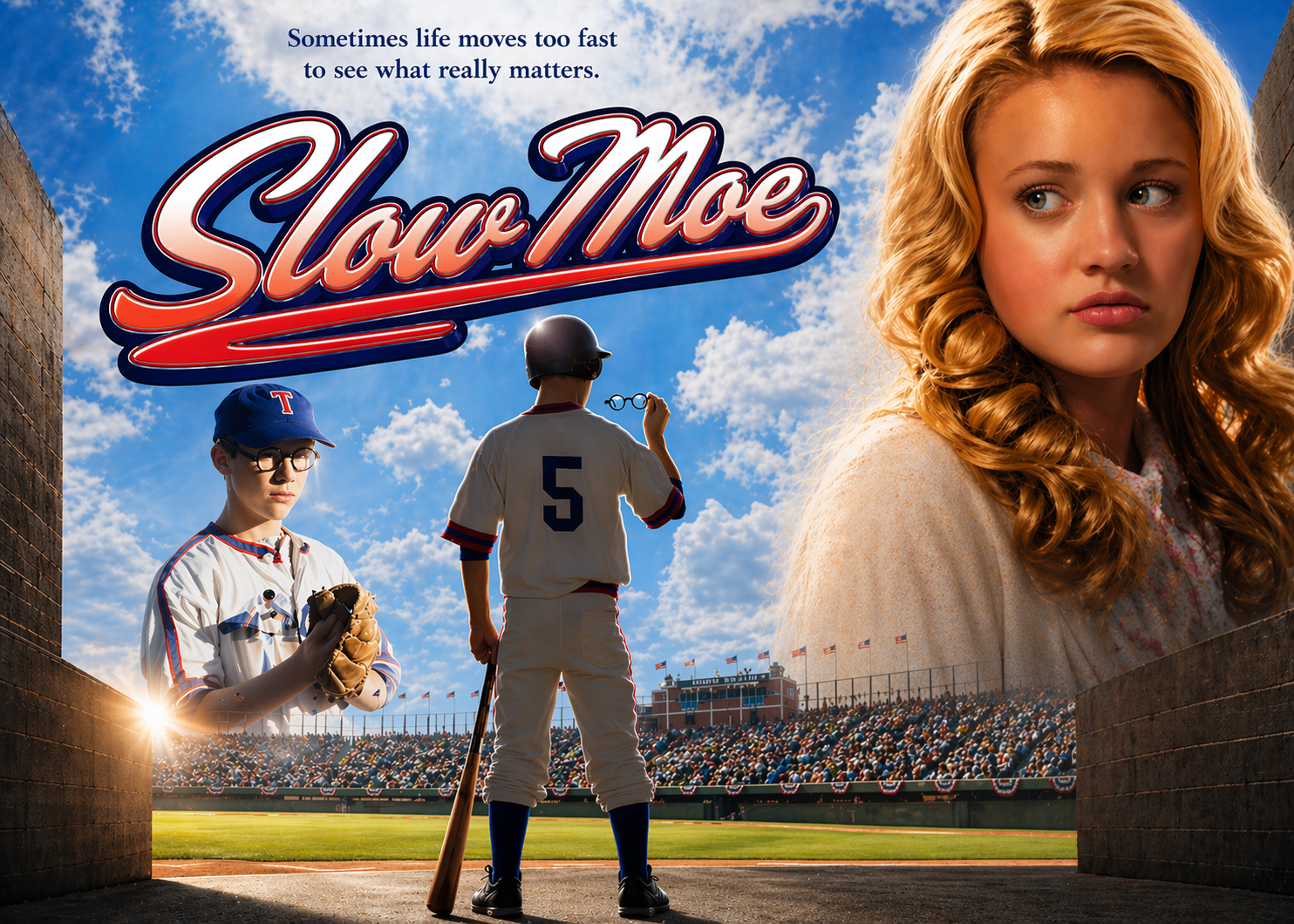
About Slow Moe
Marvin Mobley — "Slow Moe" to anyone who has ever watched him bat — has spent his whole life a step behind everyone else. His late father was a gifted athlete who died at Normandy. Marvin got the love of baseball without any of the talent, which means he shows up to every pickup game knowing exactly how it will end. Then one night, digging through his uncle's belongings, he finds a pair of Nazi-era "velocity glasses" — designed to slow down the visual perception of fast-moving objects — and his world changes overnight.
With the glasses, Marvin can see the ball moving at a fraction of its actual speed. He makes the Tornadoes — the top high school team in town. He becomes a local legend. He enjoys it. The film doesn't pretend he doesn't — and that honesty is what makes the moral weight of the story land so cleanly later. Marvin likes being good at something. He likes belonging. He likes that Coach Kerr sees him. And he keeps using the glasses because all of that feels so much better than being slow.
But somewhere underneath the wins, Marvin knows. And when the climax arrives — bases loaded, full count, two outs, final inning, the most important at-bat of the year — and the glasses are in his hand again, he gives them back. Not because he's forced to. Because he decides that whatever happens next, he needs to know it was him.
The film is set in 1958 and wrapped in a spy subplot involving Wolfgang Blitz, a WWII war criminal trying to steal the glasses for the Russians — which gives the story its adventure energy and keeps it moving. But the moral core is always Marvin, alone at the plate, choosing who he wants to be.
Winning doesn't mean anything if you can't be proud of how you played the game. Those glasses didn't play like a champion. You did. There's no reason you can't keep playing like that.— Coach Kerr, Slow Moe
Your Five-Day Journey
The Full Curriculum is on Its Way
The five-day guided program for Slow Moe is currently in development. Join the waitlist to be notified when it's ready — and to receive early access pricing.
Join the WaitlistWhat Children Are Building
Slow Moe is anchored in Self-Management and Responsible Decision-Making — specifically the temptation of a shortcut that nobody would ever discover, and what it means to choose integrity in a moment when getting away with it is entirely possible.
The Easy Win vs. the Right Win
Marvin's dilemma is completely real: the glasses work, nobody knows, and the wins feel great. The film doesn't minimize that. Children feel the full pull of the easy win before they're asked to examine the cost — and that's exactly what makes the eventual choice so meaningful.
Earning What You Get
Coach Kerr's observation lands because it's true: the glasses didn't play like a champion. Marvin did. The curriculum explores what it means to know something is yours — really yours — and how that feeling is different from anything an advantage can manufacture.
Integrity When No One Would Know
Nobody would have caught Marvin. The glasses are invisible. The coach never tested for them. The only person who would ever know is Marvin — and that turns out to be exactly enough. Children explore what it means to be accountable to yourself when there's no external enforcement.
Belonging & Identity
Marvin doesn't just want to win. He wants to belong — to the team, to the legacy of his father, to the idea of himself as someone who is good at something. The curriculum examines how that desire for belonging can make shortcuts feel justified, and what genuine belonging actually requires.
Legacy & Who We Come From
Marvin's father died at Normandy and was, by all accounts, a man of character. Coach Kerr knew him. The film draws a quiet but deliberate line between what Marvin's father left him and the choice Marvin makes at the plate. Children explore what it means to honor where you come from.
Friendship & Loyalty
Leon keeps Marvin's secret even when it strains their friendship. Emily believes in Marvin before the glasses, when nobody else does. The curriculum uses both relationships to examine what real friendship looks like — the kind that tells you the truth, believes in you before you've proven anything, and stands by you anyway.
Who Children Will Watch Closely
The curriculum asks children to observe characters rather than evaluate themselves — a key distinction that makes the learning land without triggering defensiveness.
Marvin is not a cheater at heart — but he uses the glasses anyway, because the alternative is going back to being picked last. The film honors how real that temptation is. His final choice at the plate isn't the action of someone who never wavered. It's the action of someone who wavered for a while and then decided who he wanted to be. Children recognize themselves in that arc more than in any portrait of effortless virtue.
"Marvin knew nobody would ever find out about the glasses. What made him give them back anyway?"
Leon is witty, loyal, and deeply invested in Marvin's success — which makes him the most complicated character in the film. He knows about the glasses. He keeps the secret. He also ultimately captures a WWII spy by reversing the glasses' polarity, which makes him the film's unlikely hero. Children see what real friendship looks like: someone who is with you even when they're not sure you're doing the right thing, and who steps up when it matters most.
"Leon knew Marvin was using the glasses. Should he have told someone? Why or why not?"
Emily believes Marvin should try out for the Tornadoes before he has the glasses, before he has any results to point to. She defends him from bullies. At the end, when Marvin credits her in front of the press — "she believed in me before anybody else" — it's the film's clearest statement about what that kind of belief actually does for a person. Children explore what it means to be the friend who sees someone before they've proven themselves.
"Why do you think Emily believed in Marvin even when the evidence said she shouldn't?"
Coach Kerr opens the film as a man who measures everything by winning — who told Marvin's mother there was no reason to pretend otherwise. He ends it telling Marvin that winning doesn't mean anything if you can't be proud of how you played. The transformation is earned: it takes watching a kid choose integrity at the worst possible moment to remind him what he used to know. Children see that adults can also be changed by the people around them.
"Coach Kerr changed his mind about what winning means. What do you think changed it?"
The Film's Friction Points
These are the scenes where the SEL learning runs deepest — where children feel the full weight of the story before they're asked to discuss it.
Picked Last — Again
The film opens with a pickup game in which Marvin is picked last after a moment of deliberate humiliation from the bully. Children don't need to be told how this feels. The curriculum holds space with that experience before anything else — because understanding who Marvin is before the glasses is what makes the choice at the end mean something.
Marvin Discovers the Glasses
Alone in his room, he puts them on and picks up a baseball. Everything slows. He stares. Then he swings — and hits it perfectly. The next morning he is hitting balls off the side of his house, grinning in a way children haven't seen him grin before. The curriculum doesn't rush past this moment. It asks: what does it feel like when something you've always wanted suddenly becomes easy? And what do you do with that feeling?
Making the Tornadoes
The tryout scene where Marvin hits everything Coach Kerr's son throws at him — including a surprise pitch — is pure joy. And the curriculum lets it be. The cost of the shortcut doesn't need to be announced yet. Children feel the win before they're asked to examine how it was won. That sequence is intentional: you have to understand the appeal of the easy win to understand the weight of giving it up.
Coach Kerr's Son Steals the Glasses
Bart — the bully — takes the glasses from Marvin's locker and delivers them to him at the plate during the championship game, in front of the coach. The confrontation that follows is the moral pivot of the film: Bart tells his father they can win if Marvin wears the glasses. Coach Kerr tells his son — and Marvin — that he was wrong. Winning doesn't mean anything if you can't be proud of how you played. Children watch a coach change his mind out loud, in public, at the worst possible moment to do it.
The Final At-Bat
Bases loaded. Full count. Two outs. Final inning. The glasses are in Marvin's hand. He gives them back. He steps in without them. The film doesn't tell us clearly what happens next — the crowd erupts, but the outcome is left deliberately ambiguous. Children are asked: does it matter whether he got a hit? What does Marvin know about himself now that he didn't know before? What is that worth?
"She Believed in Me Before Anybody Else"
After the game, with reporters and cameras everywhere, Marvin credits two people: Leon, who captured the spy, and Emily, who believed in him before anyone else. Not the glasses. Not the wins. The people. The curriculum uses this moment to draw the thread all the way back to where the real story started — not when Marvin got fast, but when someone decided he was worth believing in.