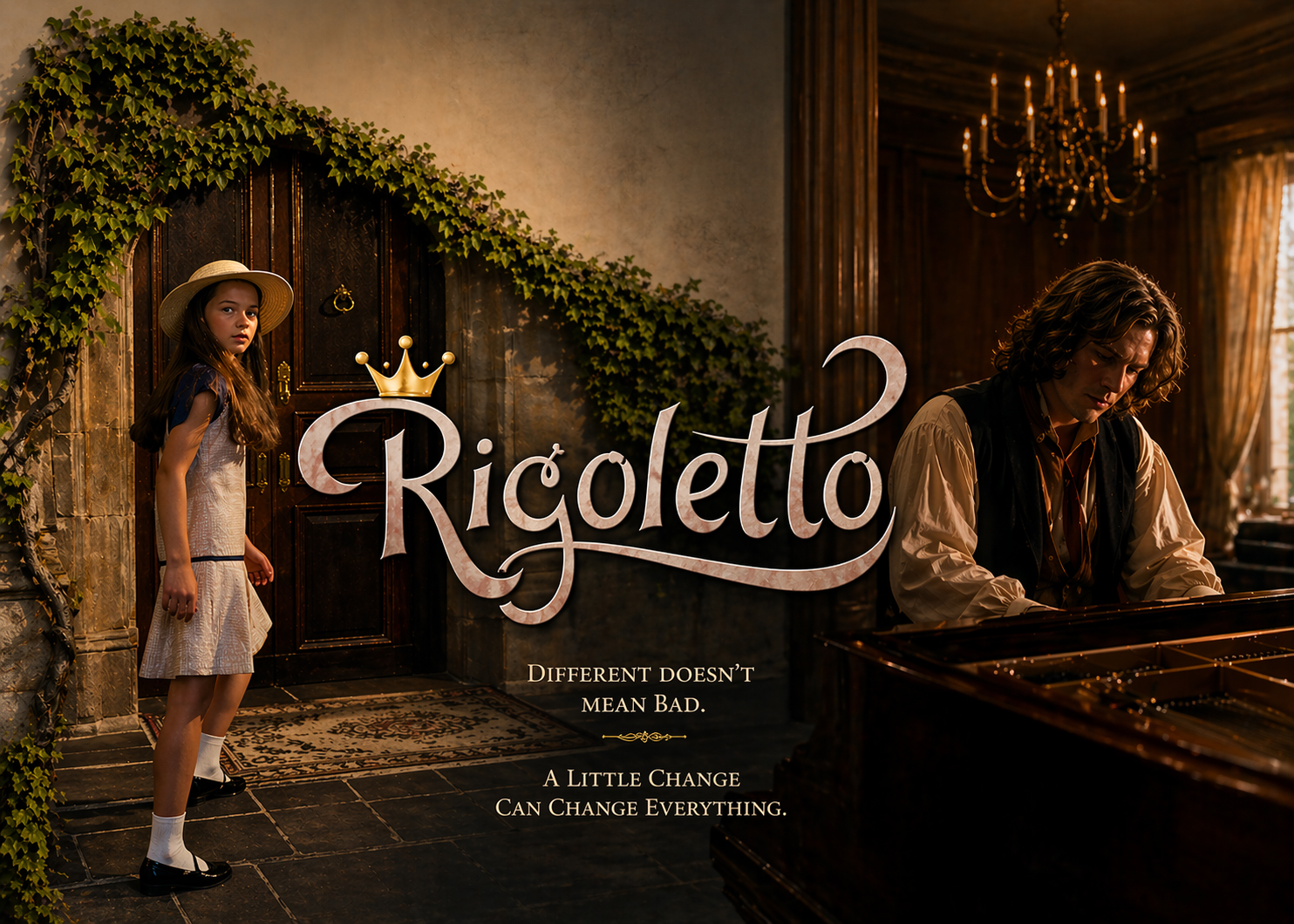
About Rigoletto
In a small Depression-era town called Castle Gate, a stranger has arrived — reclusive, wealthy, and disfigured. He never appears in daylight. He bought up mortgages during the Depression. The town has filled in the rest with fear: he is a monster, a vampire, something to be avoided. Bonnie Nelson has actually spoken with him, and she knows something the town doesn't: the man they're afraid of has been quietly paying off the debts of families who were about to lose everything.
The man is Mr. Aldi — or Rigoletto, the elfin prince of an ancient fairy tale, cursed with a disfigured face after a battle wound and exiled from his kingdom until a pure heart chooses to see him truly. He has come among men searching for that heart. What he didn't expect was Bonnie: a girl who lost the town talent competition without bitterness, who refuses to return hurt for hurt, who tells him to his face — honestly, without cruelty — that he has an ugly heart, and that is far worse than an ugly face because he can control the second but not the first.
As Rigoletto teaches Bonnie to sing, something shifts between them. She sees past what he looks like. He slowly allows himself to be seen. When the town pressures Bonnie to stop working for him, she refuses — not out of defiance but out of loyalty to what she actually knows about him, rather than what everyone else has decided. Her choice breaks his curse. Not through a kiss or a spell, but through the simple, radical act of choosing to look at someone clearly and stay.
The film is also the story of a community learning the same lesson more slowly — through quiet evidence that the man they feared has been healing their children and paying their debts and asking for nothing. They come to understand what Bonnie understood immediately: you cannot know who someone is from the outside.
You have an ugly heart. That's worse than having an ugly face. You can't control the way you look, but you can control the way you treat others.— Bonnie Nelson, Rigoletto
Your Five-Day Journey
The Full Curriculum is on Its Way
The five-day guided program for Rigoletto is currently in development. Join the waitlist to be notified when it's ready — and to receive early access pricing.
Join the WaitlistWhat Children Are Building
Rigoletto is anchored in Social Awareness and Relationship Skills — specifically the way assumptions about appearance and difference prevent us from seeing who people actually are, and what it costs a community when fear replaces curiosity.
Seeing Past Difference
The entire town of Castle Gate builds a story about Mr. Aldi from his appearance and his reclusion — and gets it almost entirely wrong. Children explore how assumptions form, how quickly they harden into certainty, and what it actually takes to look past them.
Courage to Look Closer
Bonnie's decision to go back after her first frightening encounter — and then to stay when the town tells her to leave — is the moral center of the film. Children explore what makes that kind of courage possible, and what it costs socially to be the person who sees differently from everyone else.
Honest Feedback & Hard Truths
Bonnie tells Mr. Aldi something genuinely hard: his ugly heart is his own fault, and that's worse than his face. The curriculum examines the difference between cruel honesty and honest courage — and what makes Bonnie's words land as care rather than cruelty.
What Assumptions Cost
While the town is busy being afraid of Mr. Aldi, he has been secretly paying off their debts, healing their sick children, and asking nothing in return. Children sit with the weight of what the community almost missed by deciding what they knew before they looked.
Being Truly Seen
The curse breaks not through magic but through being seen. Rigoletto has spent years being feared or pitied — never known. Children explore what it feels like to be looked at clearly by someone who chooses to stay anyway, and why that is one of the most powerful things one person can do for another.
Refusing Bitterness
Bonnie loses the talent competition to Kathleen — who is talented but unkind — and congratulates her anyway. She tells her friend: "Being bitter won't make me a better singer." This small opening scene establishes who Bonnie is before any of the larger tests begin, and children recognize immediately the quality that will carry her through everything that follows.
Who Children Will Watch Closely
The curriculum asks children to observe characters rather than evaluate themselves — a key distinction that makes the learning land without triggering defensiveness.
Bonnie is not exceptional because she is fearless. She is exceptional because she chooses to look past what she feels in the moment. She's scared of Mr. Aldi at first. She goes back anyway. She tells him hard truths. She stays when it costs her the singing competition. The film makes her courage feel available — not heroic, not supernatural, but a choice that any person could make if they decided to.
"Bonnie was scared of Mr. Aldi the first time she met him. What made her decide to go back anyway?"
Rigoletto has let the ugliness of his face poison his heart — his own words, eventually. He is gruff, wounded, and genuinely difficult to be around. He is also secretly spending his fortune on the community that fears him. Children watch a person whose outside and inside are in genuine conflict — and see, slowly, the inside winning. His final departure, healed and restored, is earned rather than given.
"Mr. Aldi was secretly helping the whole town even when they called him a monster. Why do you think he never told anyone what he was doing?"
Porter is Bonnie's friend — a boy whose father has become bitter and mean through hard times, who carries his own wound of not being loved the way he needs. His conversation with Rigoletto about his father is one of the film's most quietly powerful scenes. Rigoletto tells him something he couldn't have heard from anyone else: sometimes it takes hard times to make us gentle and strong — and his father needs love right now, even if he hasn't earned it.
"Rigoletto told Porter to love his father even though his father wasn't loving him back. Do you think that was fair advice? Why or why not?"
Castle Gate isn't made up of villains — it's made up of frightened people in hard times who have decided what they know about a stranger before they've looked. Their slow, evidence-by-evidence shift — a child walks without limping, a boy can see again, debts are paid off — is its own character arc. Children see how a community's assumptions can be wrong at scale, and how truth eventually works its way through even when nobody is listening.
"Why did the whole town believe Mr. Aldi was a monster — even though there was no real evidence? What made the rumors feel true to them?"
The Film's Friction Points
These are the scenes where the SEL learning runs deepest — where children feel the emotional weight of the story before they're asked to examine it.
Bonnie Loses — and Congratulates Kathleen Anyway
The film's opening scene tells us everything about Bonnie before the story begins. She loses the talent competition to someone who has been unkind to her, and her friend tells her she was robbed. Bonnie's response: "Being bitter won't make me a better singer." She goes to congratulate Kathleen. Children recognize this quality immediately — and the curriculum returns to it throughout the week as the foundation of everything that follows.
"You Have an Ugly Heart"
When Mr. Aldi demands Bonnie say he's ugly, she tells him something he wasn't expecting: yes, he has an ugly face, but his ugly heart is worse — and that one is his fault. He can't control the first. He can control the second. The room goes very quiet. Children watch a twelve-year-old say something that a grown man needed to hear, with honesty that doesn't flinch and without cruelty. The curriculum asks: what makes that kind of honesty different from being unkind?
Bonnie Hears Him Sing
She enters the forbidden room because she hears music. What she finds stops her completely. After the lesson, she tells her mother: "How could someone do something so wonderful if he's supposed to be so bad? And how could someone so beautiful love someone so ugly?" She has seen something the town hasn't — and she's asking the right questions because of it. Children explore what changes when you actually look, rather than rely on what you've been told.
Rigoletto and Porter — About His Father
Porter is furious at his father, who has become hard and distant through poverty. Rigoletto listens, then says something unexpected: his father is not a strong man — not yet. Meanness isn't strength. And someday, if Porter doesn't give up on him, they'll both get what they need. Children watch the disfigured recluse become the most emotionally wise person in the film — and understand why Bonnie's instinct to look closer was right.
Bonnie Refuses to Leave
When the town tells Bonnie she can't compete unless she stops working for Mr. Aldi, she goes back to work anyway. He tells her to leave — for her sake. She refuses. He says their time together is fulfilled and sends her away. She still refuses until he asks her to carry what they've built into the competition and win. Children feel the weight of a loyalty that costs something — and ask what it means to stand by someone when everyone around you says you shouldn't.
The Man at the Door
After the competition, Bonnie sees a stranger at the door of the old Aldi house — handsome, whole-faced, peaceful. He says he used to live here and is leaving for home, somewhere far away, so far away you'd never know it existed. He gives Porter something that belonged to Mr. Aldi. And then he tells Bonnie his name. The film ends in the quiet after that revelation, and children are left to sit with what they believe.