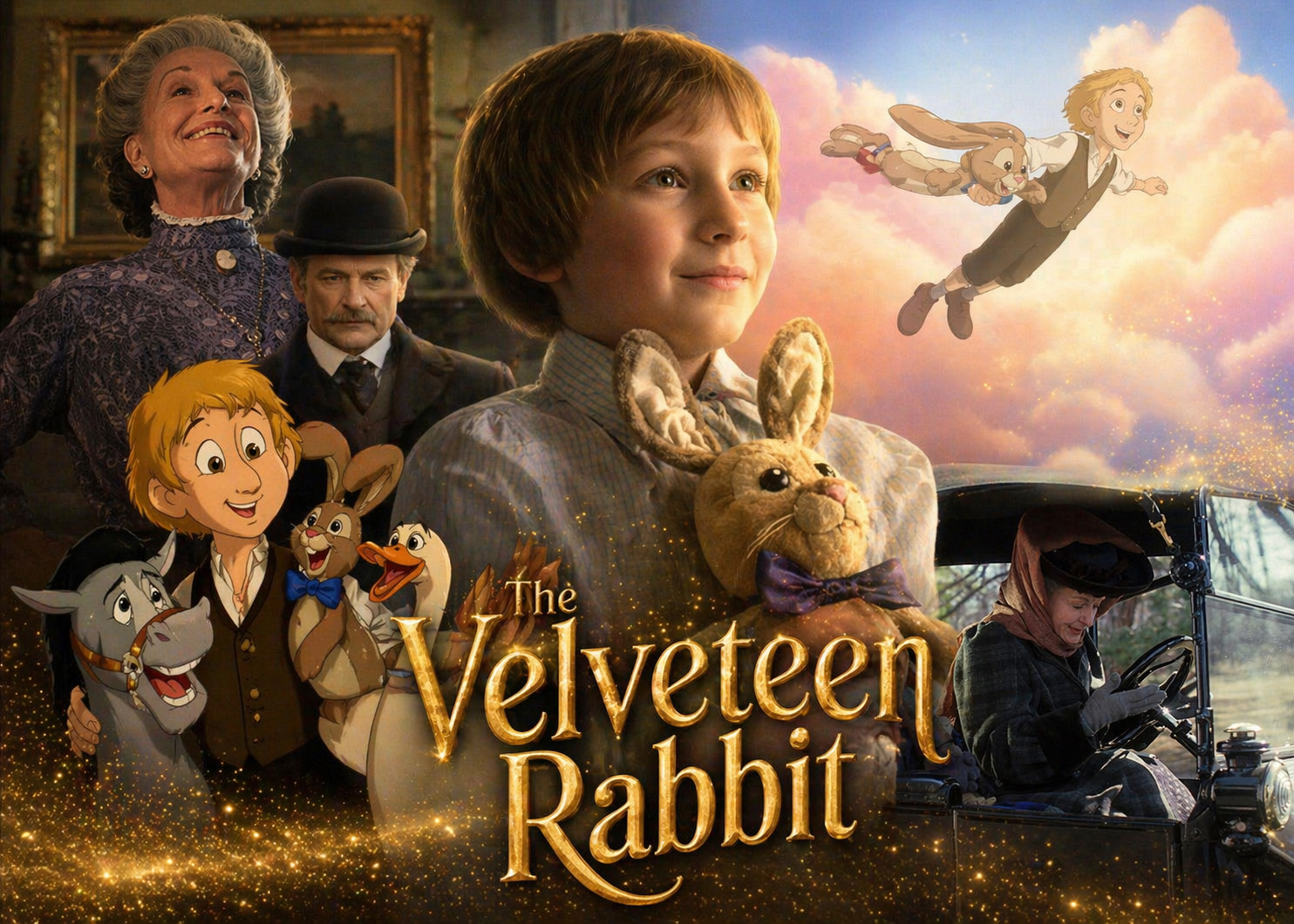
About The Velveteen Rabbit
Toby's mother has died. His father, unable to face the grief he sees in his son's face, leaves Toby with his grandmother Ellen during the holidays. Ellen is proper, controlled, and completely certain that having a boy in the house will not change her life one bit. She is wrong about all of it.
In the attic — the magic attic his father once loved — Toby finds a velveteen rabbit in a red box with a gold bow. A gift from his mother. When he hugs the rabbit and wishes him alive, something remarkable happens: the rabbit becomes real in the imagination, along with Swan (a swan toy that belonged to a young Grandmother Ellen) and Horse (a rocking horse that belonged to Toby's father). Together, in the magic world Toby creates, the four of them have adventures that slowly, carefully work on everyone involved.
What the film understands deeply is that grief makes people smaller. Grandmother shrank behind propriety. John shrank behind work. Even Rabbit is tempted to keep Toby in the imagination forever, where love is safe and nothing can be lost. Swan is the one who names it plainly: their job is not to help children run away from the real world, but to help them face it. The magic is meant to heal, not to hide.
The climax — Toby's scarlet fever, the burning of the rabbit, the real rabbit emerging from the flames — is one of the most quietly devastating scenes in the entire catalog. And the line that follows is the whole film in seven words: "It's not love that makes us real — it's loving." The act of giving love, not just receiving it, is what transforms us. John learns it in the hospital. Grandmother learns it on a bicycle. Toby already knew.
It's not love that makes us real — it's loving. Our job is to help children deal with the real world, not run away from it.— Swan, The Velveteen Rabbit
Your Five-Day Journey
The Full Curriculum is on Its Way
The five-day guided program for The Velveteen Rabbit is currently in development. Join the waitlist to be notified when it's ready — and to receive early access pricing.
Join the WaitlistWhat Children Are Building
The Velveteen Rabbit is anchored in Self-Awareness and Relationship Skills — specifically what grief does to our willingness to love, and what it takes to choose vulnerability again after loss. This is the program most suited for younger children, but its emotional depth reaches every age.
Grief & What It Does to Us
John shut down. Grandmother hardened. Both found ways to protect themselves from the risk of caring too much. Children see two different adult responses to loss — and explore what happens to a person when they stop letting love in. Toby, who has the most reason to grieve, is also the most open. Children are asked to notice why.
The Risk of Loving
Rabbit wants to stay in the imagination forever, where Toby will always love him and nothing can change. Swan tells him that's not what they're for. The curriculum explores the central tension: love is risky. You can lose what you love. And the film's answer is that the risk is always worth it — that choosing not to love to avoid loss is the real loss.
Loving vs. Being Loved
Swan's final wisdom is the most important thing in the film: it's not love that makes us real — it's loving. The act of giving love is what transforms us. John thought he was protecting Toby by staying away. What he was actually doing was withholding the thing that would have made both of them more real. Children explore the difference between receiving and giving, and which one changes us more.
Imagination as a Path — Not a Place to Hide
The magic attic is real in the most important sense — it helps Toby process grief, develop empathy, and connect with people who've closed themselves off. But Swan is clear: it's a path, not a destination. Children explore how imagination and play help us face hard things — and when they become a way of avoiding them instead.
Being Truly Seen
Toby sees his grandmother as someone who used to be fun — as "Ellie" — because Swan tells him she was. That reframe changes everything about how he treats her. Children explore what it means to see someone for who they are beyond who they're presenting, and what becomes possible when you choose to look that way.
It's Never Too Late
Horse says it in the burning treehouse: it's never too late. Grandmother learns to drive a car. John comes home. Swan flies again after years of being afraid. The film's quiet argument is that the time to start loving is always now — and that people can always choose to come out of hiding, no matter how long they've been in there.
Who Children Will Watch Closely
The curriculum asks children to observe characters rather than evaluate themselves — a key distinction that makes the learning land without triggering defensiveness.
Toby has lost his mother, been left by his father, and arrived in a grandmother's house that doesn't want him. He is still the most open person in the room. He imagines Swan back to kindness. He finds out what his grandmother was like as a girl and treats her accordingly. He tells the rabbit he loves him and means it. Children watch someone who has every reason to close off choose — again and again — to stay open, and are asked: where does that come from?
"Toby had been hurt a lot, but he kept choosing to love people anyway. What do you think gave him the courage to do that?"
Ellen arrives at the beginning of the film certain that Toby will not change her life. By the end she is driving a car she didn't know how to drive, decorating a Christmas tree she swore was a fire hazard, and letting a little boy call her Nana. The transformation is never sentimental — it's earned, one small choice at a time. Children see what it looks like when a person decides to stop hiding and discovers they're still capable of joy.
"Grandmother changed a lot during the time Toby was with her. What do you think actually changed her?"
Rabbit wants to become real more than anything — and is tempted to keep Toby in the imagination forever where that might happen. Swan helps him understand that using Toby's love to fulfill his own desire is the opposite of what love means. His final act — pushing Toby to safety at the cost of his own existence — is the most selfless thing in the film. Children sit with what it means to love someone enough to let them go.
"Rabbit chose to save Toby even though it meant the end of the life they had together. Why do you think he made that choice?"
John believed that if he kept Toby at a distance, he wouldn't have to feel the grief of losing Sarah. What he didn't understand is that the distance wasn't protecting him — it was diminishing him. His breakdown in the hospital — "I've failed him" — is the moment he finally stops hiding. His return, his tears, his first real game of stickball with his son in the snow: children see what a person looks like when they finally decide to come home.
"John thought keeping his distance from Toby would protect them both. Was he right? What was it actually costing them?"
The Film's Friction Points
These are the scenes where the SEL learning runs deepest — where children feel the emotional weight of the story before they're asked to examine it.
Toby Opens the Box
Alone in the attic, Toby finds a red box with a gold bow — and a note from his mother. He opens it to find the velveteen rabbit. Then he looks out the window at the snow and says: "Look, Rabbit. It's beginning to snow. I love to watch it fall, don't you?" The curriculum holds this moment before anything else — because children need to simply feel who Toby is before they're asked to discuss what he goes through.
Toby Learns About Ellie
Swan tells Toby that his grandmother used to be "so much fun" — that she was a little girl named Ellie who loved to laugh. Toby stares at his cold, proper grandmother with completely new eyes. Children watch the reframe happen in real time: Toby treats his grandmother differently from the moment he knows who she used to be. The curriculum asks: what would change if you always tried to see the person someone used to be — or could be?
Swan's Warning to Rabbit
"Our job is to help children deal with the real world — not run away from it." Rabbit wants Toby to stay. Swan tells him that's not what love is for. Children encounter one of the most important ideas in the entire curriculum: that imagination is a tool for facing life, not escaping it — and that if someone uses love to keep you from growing, that isn't really love at all.
Grandmother Learns to Drive
Toby says the car doesn't look hard to operate. Grandmother says "I couldn't possibly." Then she says "Could I?" Then she does it. When they arrive safely, she thanks Rabbit for the compliment that she "wasn't all that crappy." She is talking to a stuffed toy, and she is completely serious, and she is starting to come back to life. Children watch a person decide to try something she'd decided she couldn't do — and discover she was wrong about herself.
John's Breakdown in the Hospital
"I've failed him. I thought if I kept him far enough away, I wouldn't feel anything." It is the most honest sentence John has spoken in years. Grandmother's response is the film's thesis stated plainly: "Loving him is worth the risk." Children watch an adult finally admit what his grief has cost him — and are asked: what do people lose when they decide not to risk loving?
The Rabbit and the Fire
The doctor says everything must be burned — including the rabbit. Toby watches his father throw the bag onto the fire. Then, slowly, something moves inside the bag. A real rabbit emerges and hops away. Toby says: "You were right, Rabbit. Loving does make us real." The curriculum gives children space to sit with this moment — one of the most beautiful in the catalog — before asking them what it means.