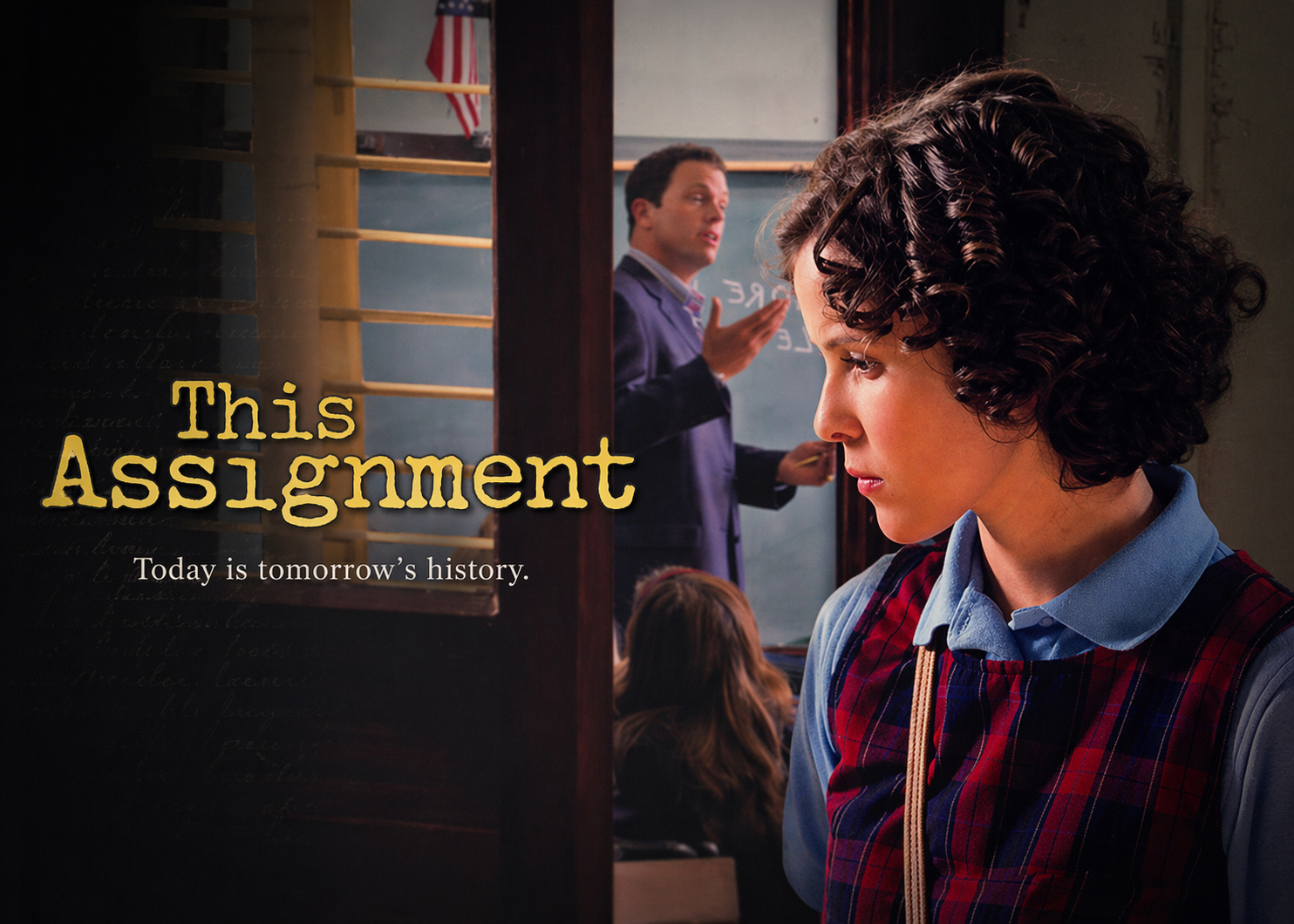
About The Assignment
Wesleyan Academy runs on an unspoken hierarchy: wealthy boarding students at the top, local "townies" who attend on reduced fees somewhere below. Mr. Price — the school's scheming vice principal — knows exactly how to use that system to protect the Blakesley inheritance he has spent years cultivating. Then Steven Clements arrives as the new history teacher, and he doesn't seem to know — or care — how any of it works.
Mr. Clements' assignment is simple in description and enormous in scope: research your own personal and family history. Not names and dates — the real story. What great deeds did your ancestors leave you? What will your legacy be to your descendants? It counts for half the grade. And it turns out to be the assignment that changes everything — because Eliza Baird, the most gifted music student at the school, has a history she hasn't been told.
Mr. Price has his own reasons to keep Eliza from succeeding. His uncle Randolph Blakesley — whose estate Price has been managing for years — has changed his will so that if Eliza earns her place at the Paris Music Conservatory, the entire inheritance is split equally between her and the school. Price engineers the forced retirement of her beloved music teacher, uses his son Billy to try to destroy her friendship with Spencer, and uses every institutional tool available to stop her.
What he doesn't count on is the assignment. Because as Eliza researches her own history, she discovers she was adopted. And as she digs further, she discovers that her birth father — a poor orphan who fell in love with Jenny Blakesley before being sent to Vietnam — is standing at the front of her history classroom. Mr. Clements is Steven Squires. The assignment leads her home.
Today is tomorrow's history. You'll look back on this moment someday and realize your whole life was changed by what you did today. Make it count.— Mr. Clements, The Assignment
Your Five-Day Journey
The Full Curriculum is on Its Way
The five-day guided program for The Assignment is currently in development. Join the waitlist to be notified when it's ready — and to receive early access pricing.
Join the WaitlistWhat Children Are Building
The Assignment is anchored in Social Awareness and Self-Awareness — specifically how institutions and hierarchies shape what we assume about people, and what it takes to see past those assumptions to find out who someone actually is — including yourself.
Identity & Who We Come From
The assignment Mr. Clements gives asks the deepest possible question: who are you, really, and what did the people before you leave for you? Eliza's search for her history becomes a search for herself. Children explore what it means to know where you come from — and whether that knowledge changes who you are.
Seeing Past Labels
Wesleyan is built on labels: borders vs. townies, rich vs. scholarship, faculty brat vs. ordinary student. Mr. Price uses those labels as weapons. Mr. Clements ignores them completely — he sees Spencer as a swimmer who can improve, Eliza as a musician worth protecting, and Amy as a student who memorized Lincoln because she wanted to. Children explore what it costs to see past what a system says about people.
Institutional Manipulation
Mr. Price doesn't bully students directly — he uses rules, procedures, and institutional authority to harm them. He forces out a beloved teacher, engineers Eliza's almost-failure, and uses his son as a tool. Children see what manipulation looks like when it wears authority as a disguise — and what it takes to see through it.
Integrity Under Pressure
Mr. Clements refuses to sign Eliza's transfer card — not out of cruelty, but because he knows dropping the class would make her ineligible for the conservatory. He takes institutional risk to do what's right for a student. Children explore what it looks like when an adult chooses a student's long-term good over short-term institutional peace.
Legacy — What We Leave Behind
The assignment isn't just genealogy — it's the question Mr. Clements came to ask: what will you leave for the people who come after you? Spencer's orphan janitor friend gives him the answer: "I had a great history teacher who told me today is tomorrow's history. Make it count. And I changed my life." Children explore what it means to live in a way that leaves something worth inheriting.
Courage to Find the Truth
Eliza could have left her personal history vague and unexamined. Instead, the assignment drives her toward the questions she's been afraid to ask — and then toward the answers that change everything. Children sit with what it means to want to know the truth even when the truth is frightening, and what becomes possible when you find it.
Who Children Will Watch Closely
The curriculum asks children to observe characters rather than evaluate themselves — a key distinction that makes the learning land without triggering defensiveness.
Mr. Clements doesn't know — or pretends not to know — that Wesleyan runs on hierarchy. He helps Spencer with his swimming at 6am because he sees potential, not rank. He refuses to let Eliza drop the class because he knows it would destroy her future, even if she doesn't. He carries his own enormous secret through the whole film. Children watch what it looks like when an adult actually sees a student — and what that seeing costs him.
"Mr. Clements got in trouble for helping students. Do you think he made the right choices? What would you have done differently?"
Eliza is talented, warm, and carrying something she doesn't know she's carrying. Her resistance to Mr. Clements early in the film isn't stubbornness — it's self-protection. The assignment forces her into territory she's been avoiding, and what she finds there is harder and more beautiful than anything she expected. Her final presentation — bringing together her two families, performing her own song — is the film's fullest expression of what it means to own your whole story.
"Eliza found out she was adopted and that her birth father was her teacher. How do you think she decided what to do with that information?"
Spencer is a local scholarship student — lower on Wesleyan's hierarchy than almost everyone else — who shows up early every morning to practice swimming because he wants to make regionals. He's funny, loyal, and quietly tenacious in a way the borders aren't. His friendship with Eliza costs him social capital. His refusal to let Billy's cruelty land without a response costs him more. Children watch someone who has every reason to give up on the institution choosing to compete on his own terms instead.
"Spencer kept showing up even when the school made it clear he wasn't valued the same way as the boarding students. What do you think kept him going?"
Mr. Price is not a bully — he is something more dangerous: an institutional operator who uses rules, authority, and social norms to cause harm without ever getting his hands dirty. He never hits anyone. He never shouts. He engineers, maneuvers, and manipulates through procedures. Children see how institutions can be used against the people they're supposed to serve — and what it takes to name that clearly enough to stop it.
"Mr. Price never broke any rules himself. So how was he causing harm? Is it possible to do something wrong without technically doing anything illegal?"
The Film's Friction Points
These are the scenes where the SEL learning runs deepest — where children feel the weight of the story before they're asked to examine it.
Mr. Price's Opening Move
In his first scene covering for the arriving Mr. Clements, Price casually reveals that he knows Eliza's parents were married exactly 16 years ago — and that she was born only five months later. He does it in front of the class, with a smile, using public humiliation as a tool to remind a "townie" of her place. Children recognize the cruelty under the politeness immediately — and the curriculum asks: how does someone cause harm while seeming helpful?
The Gettysburg Address — Nobody Had To
Mr. Clements tells the class they don't have to memorize the Gettysburg Address — it won't affect their grade. Then he asks why they all learned it anyway. Because they had to, says Amy. "No," he says. "You didn't." The scene opens into something the class hasn't felt before: a teacher interested in why they do things, not just whether they do them. Children explore what changes when someone asks them to examine their own motivation.
Mr. Clements Won't Sign the Transfer Card
Eliza is furious. She has a right to drop the class. He's overstepping. And she's completely correct on every point except one — dropping the class would make her ineligible for the conservatory, which Mr. Price never told her. Children watch Mr. Clements absorb her anger and hold his position, and are asked: when is it right for an adult to refuse what a young person wants for their own good? And how do you tell the difference between care and control?
Eliza Discovers She Was Adopted
The assignment leads Eliza to questions she's been avoiding — and to a conversation with her parents that she wasn't prepared for. The court order, the birth mother she doesn't know, the father who died in Vietnam. The curriculum gives real time to the complexity of what Eliza feels — not just the shock of the revelation, but the harder question underneath: does this change who I am? Children explore what identity is made of, and whether origin is destiny.
"Look Me in the Eye and Tell Me You're Not My Father"
Price has engineered Clements' dismissal for "inappropriate contact" — a hug. Eliza has pieced together the truth from swim team photos and yearbook pictures. In front of the dean, she confronts Clements directly: look me in the eye and tell me you are not my father. He can't. The dean tells him to tell the truth. Mr. Boudreaux confirms it. The room goes completely still. Children feel the weight of a truth that has been kept and a person who is forced to finally stop keeping it.
Eliza's History Presentation
She stands up in front of the school with both her families present — her adoptive parents and her birth mother, meeting for the first time. She says being adopted is nothing to be ashamed of. And then she performs an original song she wrote about finding out who she is. Children watch someone take the most frightening thing in her life and make it into something she offers to others — and are asked: what does it mean to tell your own story on your own terms?